

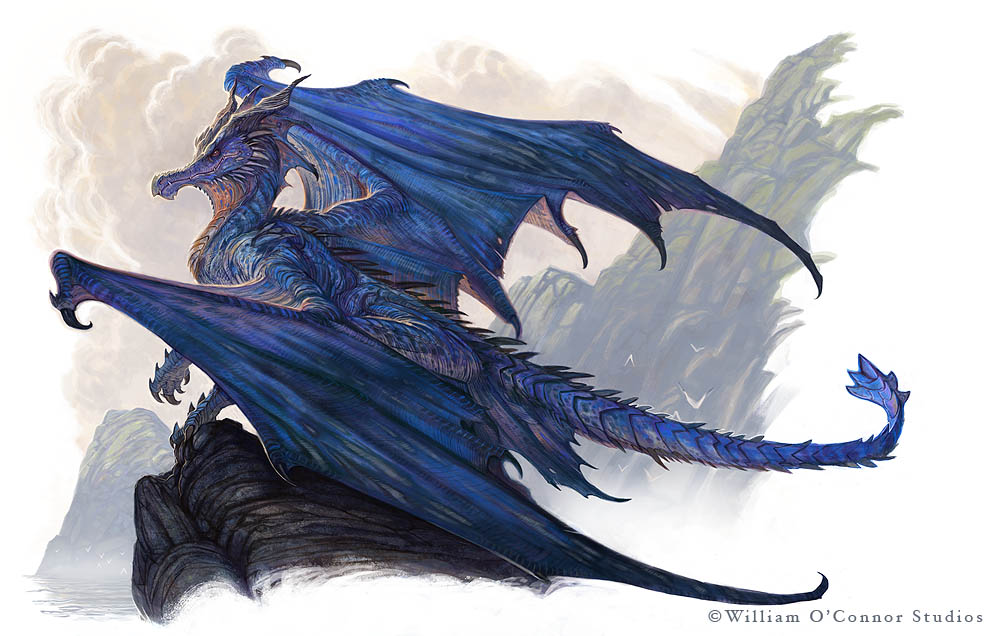
My love of dragons started when I was a boy, but as I evolved as an artist my affection for the beasts evolved as well. Artistically they are one of my favorite subjects because they offer the artist such wonderful opportunities for creativity and imagination.
Wings, tails, horns, scales and claws are the requisites of dragons, but I am always fascinated by how artists use these elements to create unique images. Composition has always been a love of mine, so I thought that I would explore how to use the elements of composition to create a dramatic dragon image.
This image “Scandanavian Blue Dragon” from Dracopedia:The great Dragons, gave me an opportunity to demonstrate some of the classic compositional elements when applied to a dragon image.
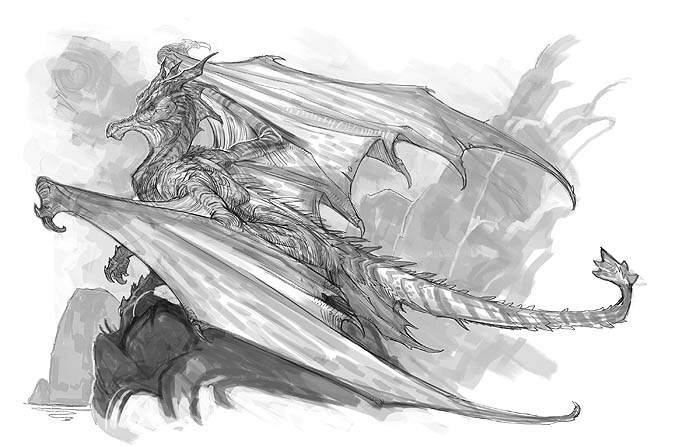
This grayscale sketch is the template for my composition tutorial: In my imagination dragons are a graceful and powerful creature. When composing them I like to use compositional design techniques that amplify that image.
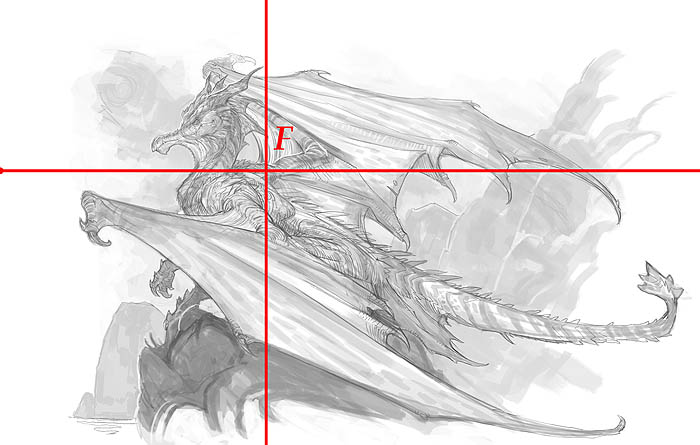
The first and most important aspect of the composition is to find the fulcrum. This is the point on which the composition balances. Dividing the composition into quadrants instantly establishes the balancing point of the design. You don’t want your dragon to look like he is going to tip over. In this image I am using the classical Golden Section ratio to establish the fulcrum with proper proportions. More on that below. In dragons this is important as to make the design feel natural.
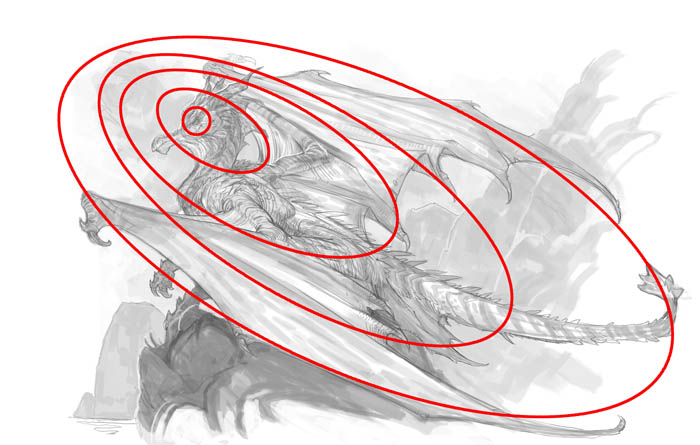
In this example I demonstrate how a series of concentric circles help to define the shape of my dragon. Like planets orbiting a sun they radiate outward from my focal point which is the eye of the dragon.
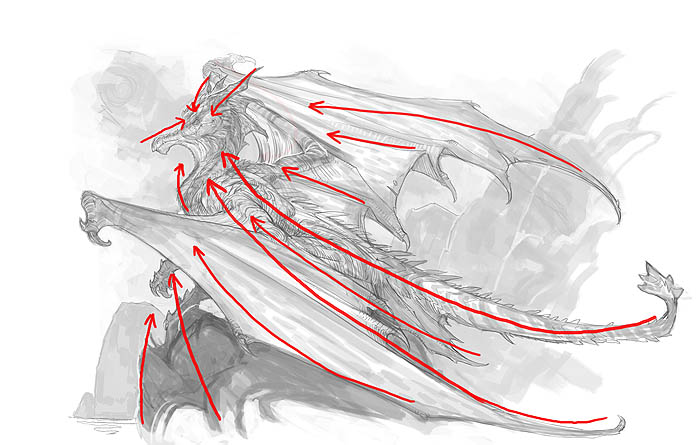
This example demonstrates how using strong curvilinear elements I am able to draw the viewer’s eye into the focal point.

Here I have over-layed a Golden Spiral (or Golden Section) onto my composition to create a classical proportion to the design. Once again the vortex of the design leads the viewer’s eye to the focal point.
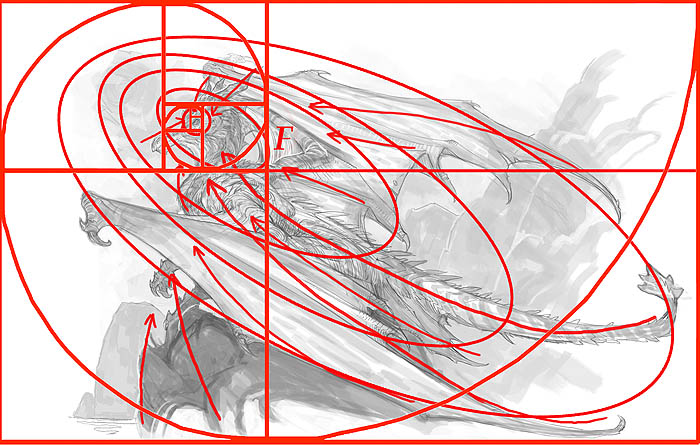
Combining all of these techniques demonstrates how composition is vital to the creation of a believable image of a dragon.
Composition is in my opinion is the most important skill that an artist can develop. I hope that these examples helped in designing your own images in the future.
Thank you,
WOC


Fantastic break down! This will definitely come very handy when I draw dragons and other winged creatures!
Thank you!
Love the in depth compositional approach. I never considered breaking down a composition in so many different ways.
Great way to double check yourself or to remedy a comp thats lacking!