

Implied lines are a very important aspect of a good composition because it is often one of the first things the viewer notices.
When painting realistically, there is no actual ‘line’ around a subject. The illusion of a contour is simply a result of different values and colors contrasting one another. But even the mere impression of a line is strong, and our eyes will go directly to it. Not only will our attention navigate immediately towards these implied lines, but our eyes then follow their entire length until that line ends, and we can thereby determine what object the contour was describing. Or, we follow the line until it meets another line, which we will then follow again, and so on. A great composition makes strong use of this natural attraction to line.
By creating strong lines for the eyes to follow, we can decide exactly what path we want our viewer’s eye to take, and more importantly, where we want that path to end.
Take for instance this painting entitled ‘Poison Sleep”. You can see a strong contour that follows along the cape, down the woman’s arm, to our subject’s face, down her arm, and then back up to the cape. This creates a nice circular ‘current’ that keeps the viewer’s eyes flowing around the composition repeatedly, holding their attention. That current also brings their eyes past every important element of the painting, one at a time.
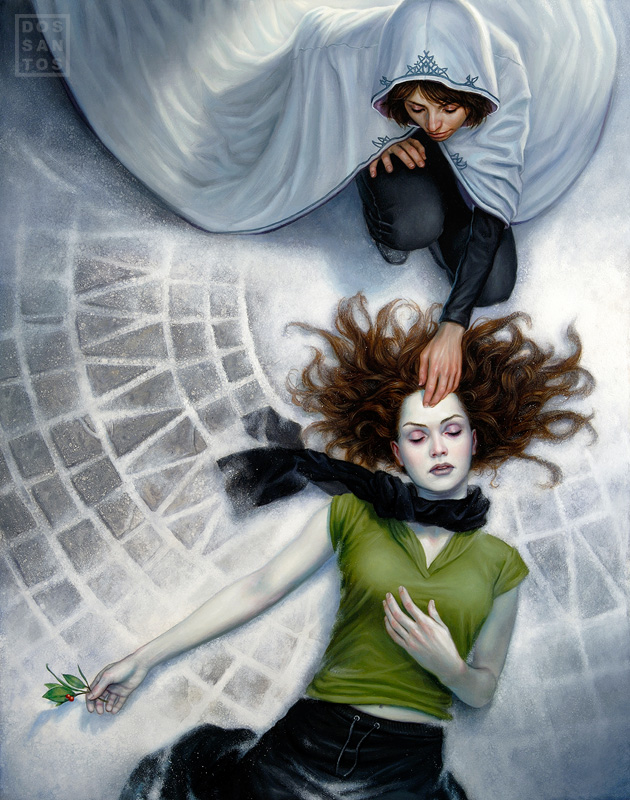

And don’t forget, whether you’re working for print or web, the borders of your composition are an implied line too!
In addition to using implied line to draw the viewer’s eye all around a composition, you can use the same method to make someone look immediately at your chosen focal point… and keep it there. In fact, you can do it repeatedly, from multiple directions. This is particularly useful when your image is a portrait or a pin-up, and the character’s face is what is most important. To bring more attention to a particular character, make surrounding objects, like arms, swords, and buildings point to your subject. You can also use implied lines to frame (or encase) the subject’s face, locking the viewer’s eyes in a general area.




its great that your covering composition, the one thing I can't get enough info on
Glad to hear it. I will be following it up tomorrow with a few more principles.
Good info! James Gurney also comments on this concept with the “Eyetracking” posts on his blog, Gurney Journey:
http://gurneyjourney.blogspot.com/2009/09/eye-tracking-and-composition-part-1.html
Is this something that just happens or do you plan (Sketch) it out before you start your work?
I think studying composition constantly in other people's work will help your own compositions without having to be so intentional about it. Once you've absorbed so much knowledge on composition, your work will naturally reflect that absorption.
Sometimes I'll work up a piece without considering composition until it isn't working or until I want to emphasize the composition that I developed unknowingly.
Oh it is -definitely- planned. It may be intuitive, and I don't really think about it… but it's never just coincidence.