


There is a series of sculptures that has captivated me for some time based on archetypal experiences. One day, during a model session, I asked our model to interact with an open-weave shawl. I was giving her cues such as, “what if this was the most precious thing in the world to you?” “what if this was your worst nightmare?” “what if this was something that fully consumed you?” “what if this was something you couldn’t escape?” to help keep her moving spontaneously. Several poses came from these sessions, including this one. I sat with this pose for many months, thinking about it, sketching it, considering why it resonated so much with me. She felt so poignant and introspective, listening to something I couldn’t quite hear, caught in the net but pushing outwards to escape its confines.
 Finally, I decided to just do the sculpture and let it speak to me as I worked on it. I figured I would come to understand the story as I brought her into being. I made the sculpture 70% life-sized, out of water-based clay, hollow building as I usually do (there are previous posts I’ve done that show this process, including this time lapse: https://www.muddycolors.com/2024/05/clay-figure-time-lapse/). It was a complicated pose for this construction method as there is no internal armature to support the weight of the clay, so the whole figure is suspended on her right toes, left toes and knee. All the parts hanging out in free space want nothing more than to collapse into a big pile of clay body parts.
I use external braces while sculpting to support the weight of all these free-floating appendages. This sculpture needed so much support, it got a little out of control with a forest of braces! It’s challenging to sculpt when there are all these obstructions in my way, but I can often move one or two as I work on a specific area. These are temporary braces made of PVC with a ball of clay on the end to prevent the edges digging into the sculpture. I use these while I’m sculpting because they are quick to grab, place and reposition.
 After the sculpting is complete, I make clay braces to replace the plastic ones using the same clay body as the sculpture. These will dry and be fired in the kiln with the piece. The PVC braces could cause cracking in the sculpture because clay shrinks as it dries (the clay would shrink and the plastic would not, so likely there would be cracking in places such as where the arms join to the torso). Plastic also could not go into the kiln as it would melt. The clay braces will shrink the same amount as the clay and can be fired with the sculpture so the weight is supported through the firing. It’s a complicated business! Once the sculpture has been fired, all the braces can be removed and she will support herself in this position as if floating.

After she was fired, Colin created an ombré finish that I love using Golden’s So Flat Matt acrylic paints. I quite liked her just as she was, but I still was intrigued with the original look of the fabric. The problem was that the shawl was blue, had sequins and I hadn’t made it. While combining sculpture with found objects can work, in this case, it absolutely didn’t. Yech!
 So I set off on a new adventure, trying to figure out how the shawl had been created. I researched with no success and asked every fiber artist I could find if they knew what it was. It was my mom who finally said, “you know, I think that looks like crochet.” Crochet? Okay. New learning opportunity. I did a deep dive online and, sure enough, it’s a crochet pattern called “Solomon’s Knot.”
I love the decorative knots and the pattern of three strings between them. Below is a more typical (and easier) version where the knots are closer together and the thread is thicker. How hard could it be, right? I got some crochet hooks, practice yarn and instructional videos. I was able to sort out the basic pattern pretty quickly, but when I tried to do it with my chosen super-delicate thread and the very open weave, it was just so not happening. I tried various things to get it to work, but no go. Either my skill level was way too rudimentary (which it was) or I was trying to do something with a material just unsuited to the task. I may have been able to figure it out in time, but I had none – did I mention I was on a deadline to complete the piece for a show? Of course I was.
 I was committed to making the fabric, so I researched other ways of making open weave patterns and came across this macramé coverup. Macramé now? Curiouser and curiouser…
This specific pattern was too chunky and clunky for what I wanted, but I adapted it.
 Based on this basic weave, I created my own new pattern that had the three strings between the knots and a more ornamental double knot accent between the threads. The added bonus was that I found thread that matched the color of the sculpture perfectly and I could re-create the ombré transitions to echo the sculpture’s finish. This made the fabric really look like it was an intentional part of the piece. This macramé version is a bit simpler than the Solomon’s Knot, but has an elaborate feel and a delicacy that I find attractive, plus the sculpture is more visible through it.
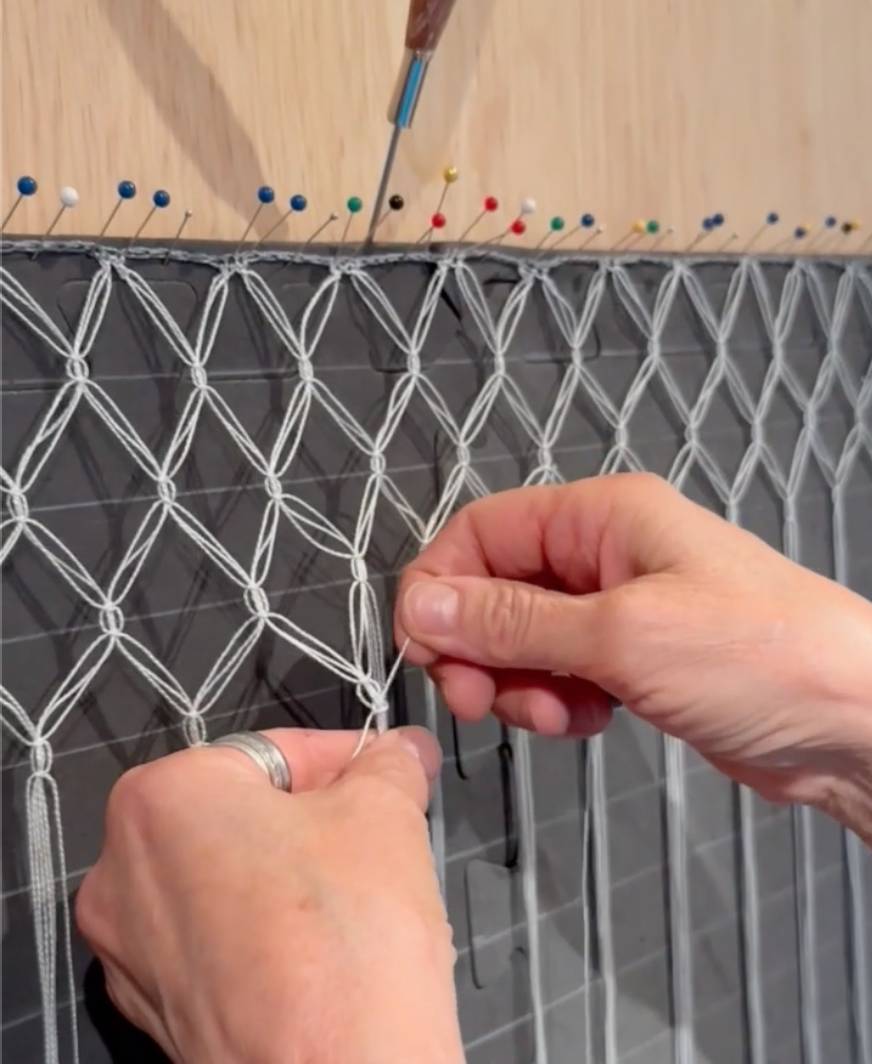 Colin set up a board with a grid and I was off and running (or knotting). Here you can see the color gradation.
  It took me about an hour for each row, which is insane. But, in for a penny, in for a pound – once I got started, I was committed. I am reminded that sometimes things just take the time they take and for me to have the piece express what I wanted it to, this had to be part of it.
  Mid-way, I took the fabric off and tried it with the sculpture. I was entranced by the effect and was inspired to keep going.
 I loved seeing her in the morning sun – how the shadow patterns shift and change across her body and face with the changing light. She was so quickly whisked off to the gallery, I didn’t even have time for a proper photo shoot.
 “The Calling”: The fabric represents a belief structure or way of life that in some way obscures or restricts you from becoming who you wish to be. It may be very pretty to look at, but it makes it hard to see the person underneath and it makes it difficult for the person to see out clearly. She “hears” something outside her current structure that beckons to her (perhaps it’s the call of the artist?). She pushes against the fabric to find that it begins to unravel at her fingertips, clearing the way for her to free herself. She is poised and ready to rise.




Hi Christine, as a painter, I almost didn’t click into this article, but was so glad I did. Thank you so much for sharing your approach to every part of your process on this project. Such great direction for the model. And I’m so impressed by your multi-step exoskeleton to get the piece to fire properly. (I thought you were going to drip the crocheted net in slip and fire it all together.) The end result is stunning!
Hi Michael, Thanks so much for deciding to take a look and for sharing your thoughts! I also find it intriguing to get to walk through someone’s problem-solving process and thinking when they come up against unexpected obstacles in the process of creating. I did a lot of dipping fabrics in slip and firing them when I was at university – with varying degrees of success. That might have been an interesting solution to try, but it likely would have made the sculpture pretty messy in the process. Most of the ones I did that survived firing were super fragile (although I know a few are still out there), but pretty cool looking. Appreciate you taking a few moments to comment! K
A powerful piece The way you describe The Calling feels emotional and deeply engaging and it really draws me into the meaning behind the work
I am so pleased to read your words. When we “release” work into the world, we never know who might find it intriguing, engaging or perspective shifting. I appreciate you sharing your thoughts on the sculpture and the article. 🙂
The Calling sounds deep and meaningful I love the reflective tone and the sense of purpose behind it Thanks for sharing this—it’s always inspiring to read something that makes you think more about direction and passion
Thank you for sharing your thoughts. One of the things I love most about art is how it can communicate across time, cultures and distance – you never know how a piece might speak to someone you may never meet. I do so appreciate hearing a bit about your experience. <3