

By Justin Gerard

Today’s post is a quickie because I am in more trouble than a fox in a hen house. A hen house guarded by grizzly bears with rocket launchers.
Due to an important project due NOW, I didn’t have time to finish my planned post on Art as it Relates to Technology and the Industro-Military Complex Throughout History. I flatter myself in thinking that it would surely have knocked some socks off. It will have to wait until a later date.
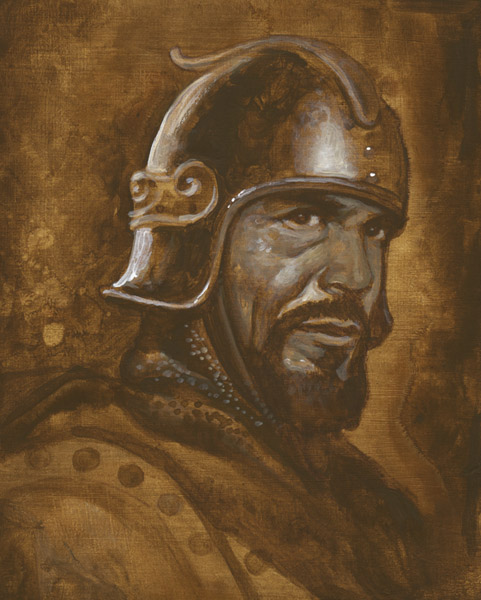
Instead, I have attached two recent experiments in water-mixable oils. As a product it may defy science and sound reason, but the more I use it the more I like it.
 |
|
Underpainting for above painting.
Colored gesso on primed MDB. |
 |
| Water-Mixable Oil on Primed MDB. |







So you don't have to use turpentine/linseed oil at all?? That sounds really interesting. Is there only one brand of water-mixable oils?
Petite,
It's true: You don't have to use any solvents if you don't want to. You can thin with just water, which I really dig. But all of the lines offer linseed oil that can be thinned with water if you prefer to thin that way.
There are actually many brands to choose from. Winsor & Newton makes a great series called Artisan that is pretty cost-effective and an easy starting place for someone hoping to try them out. Holbein makes a slightly higher-quality series in their Duo line. They both work great.
I've always wondered how this oils work, do they dry faster than normal oils? is there any noticeable difference between the types of oils?.
Sorry for al the questions, it's just that my mind can't process “water mixable oils”
Thank you Justin. After reading your post, I broke out the W&N Artisan set I've had for a few years and started a painting. I do like the ease of clean up and lack of solvent odors. I too am curious about the drying time.
Again, thanks for the inspiration. I look forward to your future post on Art as it Relates to Technology and the Industro-Military Complex Throughout History.
I've heard of watersoluble oils before. I've always preferred watermedia like acrylics and gouache since oils have to be thinned with smelly solvents and leftover oil paint is toxic.
How are these thing at drying? Do they dry as fast as acrylic, gouache, or watercolor?
I've used watersoluble oils before and some colors pretty much dry overnight. I think I'd be a little bit more concerned about longevity and strength of the paint film.
Good luck with the deadline. It seems when you've been on Muddy Colors long enough your hormones sync up. Next thing you know, same deadlines 😉
I painted with the Artisan Oils from W&N for a while and I feel it's all too sticky for me.
It seems to dry slower than normal oils as well, defo a lot slower than watercolor and acrylic.
I've burried them in my bottom drawer for now, but perhaps I will try them again in a while.
Generally speaking, you can expect water-mixable oils to dry a little faster, maybe by 30% or so. There are also a few tricks that can speed this up a lot further. With the Artisan paints, I have found that if I mix umbers into a layer, that it will usually be dry in 24 hours.
This is not the case if you use any of W&N whites though. W&N uses safflower oil for their whites. This keeps them whiter, but slows the drying rate down tremendously. I have had a heavy layer go an entire week without drying. (Which for someone raised on video games and Captain Crunch is just too long) Because of this, (and also because I like working in layers) I tend to use Holbein's whites more because they dry a little faster.
There are a few other work arounds I have found for speeding everything up while at the same time keeping the paint workable and keeping everything non-toxic and archivally sound.
Based on the comments here thus far, I think I may do a more detailed post on all of this next time.
Going to echo Justin a little here and add that I use Water Mixables exclusively, as I don't have a good place to dispose of the solvents used in classic oils. I HAVE used both, however, and I have not found any difference in the quality of the color or longevity of the paints.
Sadly, a lot of artists tend to be hesitant about this new technology in paint and so not a lot of companies make these oils. FORTUNATELY the number of companies that DO create water mixables is growing. Royal Talens has just come out with a new line that I've recently tried out, their Cobra line. The paints are buttery and smooth and have a good pigment load to them. I've only just started with that brand with a few colors, but so far I'm happy.
As far as drying speeds go, that depends on the color. As Justin said, the whites are much slower. The burnt umber seems to be extraordinarily fast. The others are somewhere in between. And there are a dozen or so mediums available to effect all of that. (impasto, linseed oil, stand oil, etc.)
Interesting read! I’ve seen “drive-by posting” happen a lot in gaming forums—people just drop download links or requests without ever engaging in the discussion. It really messes with the flow and makes genuine communities harder to maintain. As someone who often looks for legit, highly compressed PC games, I really value platforms that are more curated and interactive, not just random link dumps. Good to see someone highlighting this behavior!